


An important update for your business and your customers
As a business, we know you’re always looking ahead – anticipating industry changes and positioning your business to meet evolving customer needs. Right now, there’s a growing conversation in the plumbing and electrical sectors about hot water systems, and it’s a conversation that directly impacts your business opportunities.
With ongoing uncertainty around gas supply in New Zealand and the country’s shift toward renewable energy, many homeowners and businesses are asking questions about their hot water options. The numbers tell the story: hot water accounts for approximately 30% of household energy use, and with natural gas reserves having reduced by 27% compared to last year, customers are actively seeking alternatives.
Your customers are looking for expert guidance, and being informed about heat pump technology positions you as the trusted advisor they need. Whether you’re a plumber handling the installation or an electrician connecting the system, understanding this technology is increasingly valuable for your business.
We’ve partnered with Rheem to bring you practical information about heat pump water heaters – a technology that offers real solutions for your customers.
The future of hot water in New Zealand: Why heat pump water heaters are the way forward
New Zealand’s energy landscape is changing. With natural gas production declining, the country is shifting toward cleaner, more sustainable energy sources. While there’s no immediate ban on existing gas connections, the writing is on the wall: the future is electric, and increasingly renewable.
This transition aligns with New Zealand’s climate targets and its commitment to a net-zero carbon future. For plumbers and electricians, this presents a unique opportunity to lead the change by installing heat pump hot water heaters where possible.
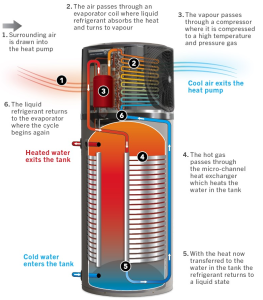
Heat pump hot water systems tick the sustainability box. By using the heat energy from the ambient air instead of drawing heavily from the grid, they dramatically reduce carbon emissions. Heat pump water heaters are significantly more efficient than conventional electric or gas cylinders, using up to 70% less water heating energy to produce the same amount of hot water – cutting hot water energy use by 50% or more. With a Coefficient of Performance (COP) equivalent to operating at 400% efficiency, a heat pump water heater can deliver more than four units of heat energy for every one unit of electricity consumed.
Installation best practices
Installing an outdoor heat pump water heater often requires no additional work when compared to any outdoor mains pressure hot water cylinder. And switching from gas to a hot water heat pump is a smart move for both the environment and the wallet.
- Location matters: The unit must be installed outdoors to ensure proper air movement. Rheem include clearance diagrams with all their models.
- Site Preparation: Install the outdoor unit on a flat, stable, and well-supported base, such as a concrete slab or treated timber platform. If feasible, place the heat pump where the old gas unit was and reuse the existing pipework when possible.
- Noise awareness: While modern units are quiet, placing them away from bedrooms or living areas is a good practice.
- Smart controls: Familiarise yourself with timer settings and energy-saving modes – these can make a big difference in performance and customer satisfaction.
- Refrigeration engineer: Rheem AmbiPower and Ambiheat models don’t require a refrigeration engineer at the time of installation. Straight out of the box, plug and play!
- Condensate Drainage: Heat pumps produce a significant amount of condensate water, so plan for a nearby drainage point and connect it to a drainpipe to manage water – or this could discharge into an outdoor planted area where the water can be absorbed and not cause a nuisance.
- Electrical connection: A certified electrician must complete the electrical wiring and connection to ensure compliance and safety.
- Gasfitter requirements: If switching from gas, a gasfitter will be needed to remove the gas continuous flow or storage water heater and cap off the gas supply.
What this means for your business
This shift represents a genuine business opportunity. As customers seek alternatives to gas and look for ways to reduce their energy costs, heat pump installations offer a solution that delivers both environmental and economic benefits. With gas prices having risen 33% in the past year alone, customer interest in efficient alternatives is only growing. Training your team – including your apprentices – on heat pump technology now means you’ll be ready to meet this demand.
For our apprentices learning their trade with you, this is an exciting time. They’re not just gaining traditional skills – they’re becoming experts in the technologies that will define the next generation of New Zealand’s building services industry.
You can check out Rheem’s Training for Tradies – a resource to learn more about their products.

Lorem ipsum dolor sit amet consectetur adipisicing elit. Voluptates sequi dolorem quaerat, iure ab, ratione dolore et voluptate dolorum, expedita nam impedit pariatur qui esse magni. Fuga quidem aliquid facere.